Water
447
million m³ a year
of desalination capacity. About 1.8 billion targeted for 2031.
Minister of Equipment and Water, 2 November 2026
No. 01 · November 2026 · Pilot edition · Free
Building fast, keeping our options
Big choices, explained
Editorial
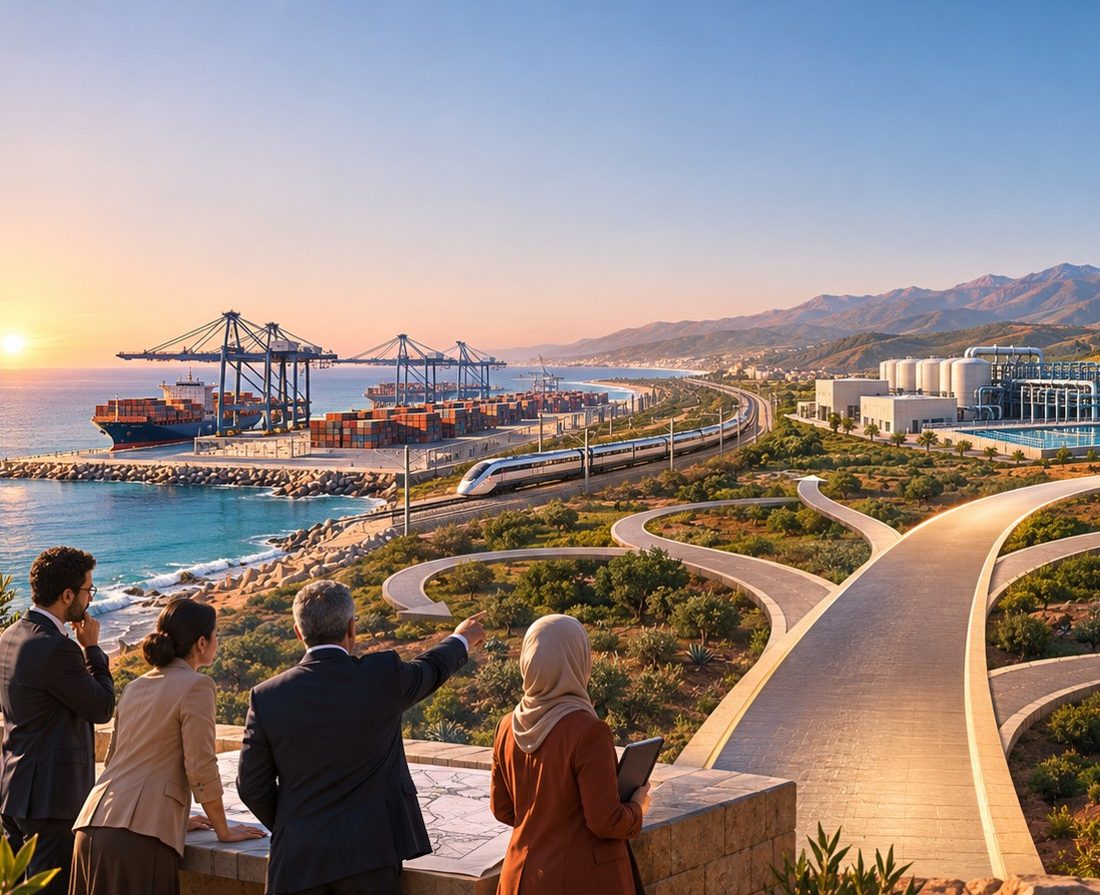
By 2030, Morocco is building fast: desalination, trains, ports, stadiums, artificial intelligence. These projects will change daily life, from the water in our taps to the way we travel.
Some choices commit us for twenty-five years or more. The further we go, the more a correction costs.
The question is not: “should we build?”
The question is: “what will we still be able to correct?”
This magazine does not grade projects. It shows what is known, what is not known yet, and what we can ask.
Aziz Skiredj, TENIR Labs, Casablanca
How to read this magazine
Major projects are moving on several fronts at once: water, rail, ports, stadiums, energy, artificial intelligence.
Some commitments last a very long time: the west terminal of Nador West Med port is granted for 25 years.
The real risk is not building. It is losing the ability to correct course if an assumption turns out wrong.
The question to remember
Before the next signature, what can still be changed, and who will be able to decide?
The big picture
Four projects, four markers. These are announced budgets and targets, not results.
Water
447
million m³ a year
of desalination capacity. About 1.8 billion targeted for 2031.
Minister of Equipment and Water, 2 November 2026
Rail
96
billion dirhams
for rail by 2030, including 168 new trains.
ONCF
Port
25
year concession
for the west terminal of Nador West Med. €280m for phase 1.
Marsa Maroc, 2025
AI
200,000
people to train
or certify by 2030. 50,000 jobs targeted.
Morocco AI 2030 roadmap
A target is not a result. A capacity is not a service. A budget is not value created. A concession is not proof of traffic.
The big picture
A big decision is like a road that forks. At the start, you can still take another way. The further you go, the more turning back costs.
The contract. Getting out has a price.
The money. Once spent or borrowed, it may not come back.
The technology. Switching suppliers takes time.
The organisation. Teams and budgets follow one choice.
The public promise. An announced project becomes a symbol.
A simple test: if a key assumption turns out wrong tomorrow, what can be changed first? Not stopping everything: knowing where the exits are, who holds the key, and how long it takes to open them.
Water
Facing drought, Morocco is investing in desalination: turning seawater into drinking water. On 2 November 2026, the Minister of Equipment and Water reported annual capacity of 447 million m³, with a target of about 1.8 billion by 2031.
Announced capacity is not the water running from your tap. What to watch: the volume actually delivered, in the right place, at a bearable price.
Before each expansion, publish the full cost per m³ and scenarios: drought, energy prices, demand.
Ports and trains
At Nador West Med, the west terminal is granted to Marsa Maroc for 25 years. First phase: €280 million, with operations planned from 2027.
A quay does not guarantee ships. A port is worth the roads, rail and customers it really attracts. Is the expected traffic new, or taken from another port?
ONCF is running a MAD 96 billion programme to 2030 and expects nearly 100 million passengers in 2030, up from 55.6 million in 2025.
A passenger forecast is an assumption. It is worth comparing, year after year, with actual ridership.
Which assumption has changed? Which cost has become irreversible? What happens if traffic stays below the forecast?
World Cup 2030 · Special report · 4 pages
On 11 December 2024, FIFA awarded the 2030 World Cup to Morocco, Spain and Portugal. Morocco is offering six stadiums: Benslimane, Rabat, Tangier, Marrakech, Agadir and Fez.
In Benslimane, between Casablanca and Rabat, the Grand Stade Hassan II is being built, due in early 2028. The venue for the final has not been decided: FIFA said so again in August and September 2026.
115,000
announced gross capacity in Benslimane
80,000
all-seater minimum set by FIFA for a final
These figures are not directly comparable: one is announced gross capacity, the other a minimum number of seats. They still raise the question of everyday scale. The tournament lasts just over a month; a stadium serves for decades. After the last match, who will fill the stands and pay for upkeep?
The stadium without a crowd South Africa 2010 · Brazil 2014
Polokwane (2010) and Manaus (2014) had no big club to fill their new stadium. In 2015, the one in Manaus cost about $233,000 a month to run.
The forgotten train Brazil 2014
Stadiums had to be ready on time; transport projects could be dropped from the list. By 2013, thirteen had been cancelled, in ten host cities.
The tenant who came late Cape Town · 2010
It took until 2021 for a club, the Stormers (rugby), to move in, leaving its own ground to do so. The deal signed in 2023 runs for 39 years.
The promise to shrink Russia 2018 · Qatar 2022
Russia planned temporary, removable stands. Qatar promised to remove some 170,000 seats and dismantle Stadium 974; in January 2025, it was still hosting a match.
The lesson learned Portugal · 2004, then 2030
After Euro 2004, Leiria and Aveiro considered demolishing stadiums too costly to maintain. For 2030, Portugal is offering only the three stadiums of its big clubs.
These cases offer no single recipe. They ask the same question: who will use the stadium year-round, and with what upkeep budget?
The tenants. In October 2026, Federation president Fouzi Lekjaa announced that Raja, Wydad and the national team will play there, even before 2030.
Access. A station is being built near the stadium (contract awarded in March 2026); commuter trains are to link it to Casa-Port and the airport.
Contracts counted. The initial envelope announced was about MAD 5 billion. In October 2026, Le Desk counted MAD 13.6 billion in contracts launched or awarded around the project. The scopes differ; the second figure is not a final cost.
Two lessons are already learned: a resident club is announced, the train is planned with the stadium. A quieter risk remains: filling one stadium can empty another. Mohammed V was renovated and reopened in April 2025, Rabat’s Moulay Abdellah rebuilt: one crowd for three big stadiums.
This report draws on the public documents cited. The organisations concerned may send clarifications to TENIR.
Created by Law 35.25 in 2025, the Morocco 2030 Foundation prepares, organises and promotes international football competitions entrusted to Morocco up to the 2030 World Cup. The law does not specify who will operate the facilities after the tournament.
Sign the use before opening day. A public contract with the clubs: length, matches, rent. Cape Town signed one thirteen years after.
Plan for everyday capacity. Close part of the stands on a league night, without maintaining the whole stadium.
Publish the full cost, kept up to date. Construction, access, station, upkeep: an explained gap reassures more than a frozen figure.
Put a date on every promise. Who will operate each facility after 2030, under which contract, and with what oversight?
Who will play in Benslimane on a Tuesday night in February 2031? How much does a season of upkeep cost, and who pays? What will become of the Mohammed V complex?
Digital
The “Morocco AI 2030” roadmap, unveiled in January 2026, targets 50,000 jobs and 200,000 people to train or certify. On 29 September 2026, the Ministry of Digital Transition and Mistral AI announced two initial models for Darija and plans to release them as open source.
Real progress, which lets us ask three questions that apply to any AI used by a public service:
Hosting it in Morocco answers the first question, not necessarily the other two.
When an AI touches a right or a budget, an authorised person must be able to stop and review its decision.
A real case
In July 2026, the European Bank for Reconstruction and Development (EBRD) approved a loan of up to €250 million to ONEE, to modernise drinking-water production and cut water losses.
plus a €5m grant
This split creates a useful checkpoint: before committing the second part, things can be checked.
This page describes the public documents cited. The organisations concerned may send clarifications to TENIR.
The method
Will there still be time to correct? MC = days left before the decision point minus days needed to spot, decide and fix a problem. A negative result signals too little time.
Imaginary example
45 days before signing, 52 days to correct: 7 days short. Move the date, shrink the order or correct faster.
How much is committed before the evidence? EHV adds the unrecoverable portion of commitments that depend on decisive assumptions still unverified, in dirhams or euros.
We say so, and we name the missing documents: a published unknown is better than invented precision. For the projects in this issue, public documents are not enough.
MC and EHV are two experimental TENIR measures, not an overall score or an assessment of projects in this issue.
Quiz and sources
Announced desalination capacity is the water that reaches your tap.
The west terminal of Nador West Med is granted for 25 years.
FIFA has already chosen the stadium for the 2030 final.
Hosting an AI in Morocco is enough to stay in charge of its decisions.
The EBRD loan to ONEE is fully committed.
Sources checked on 9 November 2026. Corrections: none so far (9 November 2026).
Your turn
Do you lead a public or private project? Propose it for a future TENIR report. Selection is editorial and does not promise favourable coverage.

Scan to answer
Answer the three questions →The PDF is designed for print. For text search or screen-reader use, read the web edition.