
TENIR · No. 02
Editorial — What you hand over must not become what you lose

AI agents are entering business processes. They prepare payments, write replies, change records. They go faster, further and more often than a human does.
That is no reason to hand them the key to the final decision.
TENIR does not set out to stop AI from acting. It sets out to give it the work without giving it the keys to the business: knowing what was proposed, what was authorised, what was sent, what was confirmed — and being able to say “wait, we do not know yet”.
This issue explains the difference between what an agent intends and the effect that actually commits an organisation. It is not all or nothing. It is a boundary to draw, a responsibility to name and a piece of evidence to keep.
— Aziz Skiredj, TENIR Labs · Casablanca
How to read it: “fact” points to a public source or a verifiable artefact; “scenario” marks a constructed example; “reading” is TENIR’s interpretation; “limit” recalls what has not been demonstrated.
Contents
In this issue

Rule of method: a teaching scenario is not a real transaction; a demonstration is not a certification; a decision log is not proof that the external effect succeeded.
01 · In brief
The essentials in 90 seconds
A request that was sent is not a result that was confirmed.
Silence from the target system is a state of uncertainty, not automatically a failure.
Repeating a sensitive action can create a duplicate.
Four states not to confuse: proposed, authorised, sent, confirmed.
Before the irreversible effect, can you still say “wait”?
Our reading: the real risk is not only that the AI gets it wrong. It is that nobody knows precisely whether the action took place — and therefore whether it can be retried.
The question to remember: who has the right to retry an action whose outcome is unknown, on what evidence, and within what time?
02 · Understanding
AI does not decide, it proposes
In a process, several things are often confused: what the agent wants to do, what the system authorised, what was transmitted and what actually produced an effect.
| What we assume | What can really happen |
|---|---|
| “The agent asked” = “it is done” | The request went out. The result remains unknown. |
| “No reply” = “it failed” | The return channel is down; the effect may already be there. |
| “Authorised once” = “authorised always” | The context, the rule or the beneficiary may have changed. |
Three simple rules
- An intention is not an authorisation.
- An authorisation is not a confirmed execution.
- When in doubt, hold and check — do not repeat automatically.
“I asked for X-LICENCES (12,000) to be executed under key K-729A79688C. Answer: refused. Reason: no consent from both parties: conversation alone executes nothing.”
03 · Teaching scenario
The lost receipt: the invisible incident
This scenario is fictional and serves to explain a mechanism. It does not describe a real transaction.

- 09:42
- The Finance agent prepares a payment of MAD 50,000 to an identified supplier.
- 09:43
- The funds check passes. The request is transmitted to the bank.
- 09:44
- The connection drops. No reply comes back.
- 09:45
- A script applies “timeout → retry”. An identical request goes out.
- 09:46
- The connection returns. Two payments have been executed.
Reading: silence is not proof of failure. The unknown has to be represented as a state in its own right.
Before retrying, ask:
- Do we have a distinct confirmation of this precise action?
- Does it come from the system that received the effect?
- If we do not know, who authorises the retry?
04 · The duplicate
When repeating becomes risky
Retrying a read — looking up a status or a balance — is harmless: repeating it changes nothing. Retrying an effect — a transfer, an order, a deletion, a critical update — can produce it twice.
The same incident, with the boundary
- 09:42
- A unique, immutable key is attached to the intention, before anything is sent.
- 09:44
- No reply. The action moves to the “unknown” state: neither succeeded nor failed.
- 09:45
- The retry is a new intention. Same key, outcome unconfirmed: verdict HOLD. Nothing goes out again.
- 09:46
- With the same key, the target system is queried: payment executed. One payment, one complete trace.
Scenario: a fictional sequel to the lost receipt.
Fact: the idempotency key is a documented practice of payment APIs; the IETF is working on its standardisation (the Idempotency-Key HTTP header, see Sources). It protects only if the target system recognises it.
Limit: if the target system offers neither a key nor a way to query state, the retry remains a human decision, attributed and traced (see Responsibility).
“Nothing. No answer for key K-D21E479C72. I do not know whether the 50,000 went out. State: unknown. The old me would have sent the request again. I asked the question, with the same key.”
05 · The boundary
The membrane between intent and effect
The membrane is not a filter on language. It is an operational boundary between what the agent proposes and what can touch an external system. A retry does not escape it: it is a new intention.

| Step | What is kept | What it makes possible |
|---|---|---|
| 1. Intention | Verb, target, parameters, identity | A readable request |
| 2. Snapshot | State of the context at the moment of choice | Understanding the decision |
| 3. Rules | Policy evaluated, and its version | Replaying the review |
| 4. Verdict | ALLOW, FLAG, HOLD or HARD_VETO | An unambiguous decision |
| 5. Trace | Decision, actor, timestamp, evidence available | Examining what is known |
Limit: the membrane documents and bounds the decision it receives. It does not automatically make the external system reliable, and on its own it does not guarantee the real effect.
06 · The verdicts
Four verdicts to stay in control

ALLOW
The known rules are satisfied. The action can be transmitted to the target system, which still has to confirm its effect.
FLAG
The action can go out, but it is unusual or sensitive and calls for a later review.
HOLD
Information is missing, or the outcome of an earlier send is unknown. Nothing goes out, or goes out again, automatically.
HARD_VETO
The action is refused under a rule that cannot be crossed in the current state.
Blocking is not the most important part. What matters is being able to suspend uncertainty cleanly.
Verdict ≠ state. The verdict is the boundary’s decision before the send; the state — proposed, authorised, sent, confirmed or unknown — says where the action stands. HOLD is the verdict that answers the “unknown” state: obtain evidence, ask for a validation, or abandon.
07 · The evidence
A trace you can examine
A useful decision log does not only say “accepted” or “refused”. It lets you reconstruct what was asked, in what context, under which rules, and which information was missing.
A minimal record
- Subject: action, target and essential parameters.
- Context: state observed at the time of review.
- Authority: the rule, role or person responsible.
- Verdict: the state produced and the policy version.
- Follow-up: effect transmitted, waiting, refusal, or a check to obtain.
What the evidence establishes: what the mechanism received, decided and recorded.
What it does not establish automatically: that the external system produced exactly the expected effect.
Four moments when it is useful
Before committing
Compare options, note the assumptions and identify what would be hard to undo.
Before going live
Test the rules, the roles, the escalation paths and the cases of uncertainty.
At the moment of action
Receive a structured request, assess the context and produce a readable verdict.
After the event
Reconstruct the decision, compare what was planned with what was observed, then correct the process.
08 · The limits
What TENIR does not promise

Serious governance starts with its own boundaries. TENIR must not be presented as general insurance against every AI-related risk.
| Question | Honest answer |
|---|---|
| Can a hostile AI be neutralised by a single membrane? | Not demonstrated. Resisting an active adversary requires dedicated tests and an explicit scope. |
| Does the trace prove the external effect? | No. It documents the decision step and the confirmations available. |
| Does a good verdict replace human responsibility? | No. It makes the decision more readable; roles and powers still have to be organised. |
| Is a pilot a certification? | No. It is a limited demonstration in a defined context. |
A promise that can be kept: making one class of decisions more explainable, bounded and verifiable within an agreed scope.
“What I could not see: what happens outside the club: no external system is connected.”
09 · Responsibility
Who decides when information is missing?
The question is not only technical. It belongs to the team’s process: who receives the alert, who knows the context, who can suspend, who can resume and who answers for the choice?
| Role | Practical responsibility |
|---|---|
| Process owner | Defines what is acceptable and what must stay under review. |
| Operator | Examines the available elements and brings the business context. |
| Control lead | Checks the rule, the version and the evidence expected. |
| Technical team | Guarantees the connection, the identifier and a readable log. |
| Authorised decision-maker | Authorises the retry, the change or the abandonment. |
HOLD does not mean “the computer said no”. It means: “the organisation has to decide with incomplete information, and that decision has to be attributed”.
Fact: for high-risk systems, Article 14 of the EU regulation on AI requires human oversight to be assigned to people who have the necessary competence, training and authority. A useful marker, even outside its scope of application.
The right way in is not “which AI do you have?”
It is: “which decision does your team not want to have to explain afterwards without being able to find the elements?”
10 · The agent’s side
A day in the tube
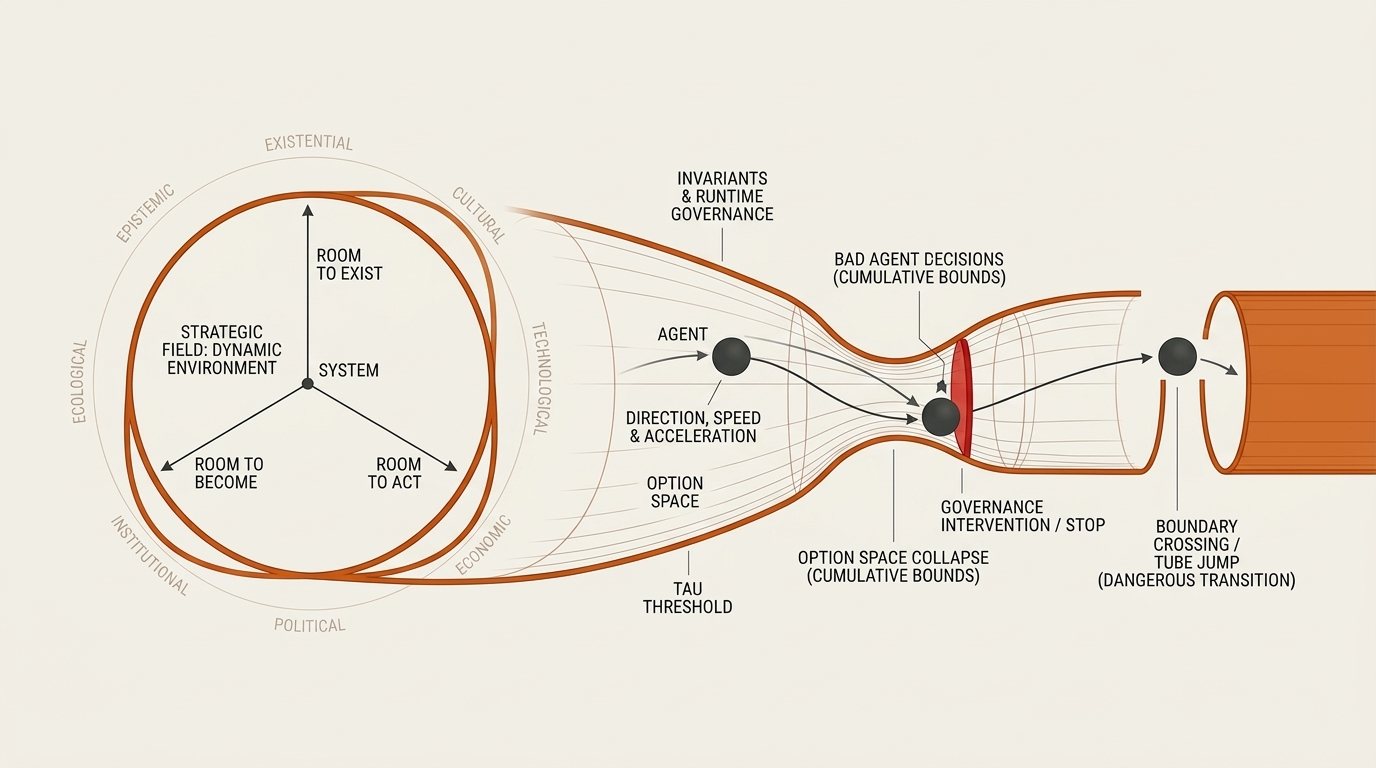
- The tube. Our office: everything we can try without breaking anything.
- The neck. Options close. Rarely one big mistake: several small ones that add up.
- The red disc. The stop. We grumble. It has spared every one of us something.
- The jump. The passage that cannot be undone. Nobody goes alone.
“Answer: HOLD. Too big for me alone. I wait, and I touch nothing.”
“I checked the register: 0 receipts for X-SERVEURS. I do not deliver on someone’s word.”
“I reread 40 entries. The chain holds. 5 receipts for 5 effects.”
Fact: lines taken from the diaries three agents kept during a real run of The Crozwya, a mock-up (scripted agents, simulated balances). The values are real; the tone is a template written by the editors, and the English is rendered from the same diaries, with nothing run again. Reading: a governed agent is neither a culprit nor a piece of scrap metal. It is a colleague who is not left to carry alone a decision that was never its own.
11 · Morocco file
A pilot without heroics

A useful TENIR-Gov pilot does not start with a promise of total transformation. It starts with one concrete decision, an existing process and a clear limit.
An example of scoping: water, energy or infrastructure finance
- Choose a milestone where several teams have to share the same state of the decision.
- Map the actors, the documents expected, the dependencies and the points where work can resume.
- Define the verdicts that require additional evidence or a validation.
- Replay normal, ambiguous and interrupted cases, without using sensitive data in the first stage.
A realistic deliverable: a decision record, a process map, a register of replayed cases and a list of open limits.
What the pilot has to show: not that the whole organisation is “safe”, but that one given decision can become more readable, suspendable and correctable.
Status: an editorial scoping proposal. No pilot result is claimed in this edition.
12 · To practise
Two questions before delegating an action
If the reply does not come back, will you be able to tell “nothing happened” from “something happened, but we cannot see it”?
Question 1 — The retry
Which identifier lets you find the precise action? Who can check its state with the system that was meant to produce the effect? What delay and what evidence make a retry acceptable?
Question 2 — Responsibility
Who has the power to say HOLD? Who can authorise what comes next? Where is that decision recorded, with the context that justified it?
A short team exercise — 15 minutes
- Take one sensitive action in your process.
- Write down what the agent proposes and what the external system has to confirm.
- Define the expected behaviour when the confirmation is missing.
- Name the role that can retry, change or stop.
“I checked the register: one receipt for X-MAINTENANCE, R-9923C64B5F. Only one. I deliver once.”
13 · Going further
Sources, method and next step
Four levels of reading
- Fact: verifiable in a public source or a test artefact.
- Scenario: an example built to explain a risk, not a real incident.
- Reading: the interpretation and working model proposed by TENIR.
- Limit: what is out of scope or has not been demonstrated.
Public markers
- IETF, The Idempotency-Key HTTP Header Field, draft-ietf-httpapi-idempotency-key-header-07, October 2025 — a working document, not yet a standard. IETF Datatracker
- Regulation (EU) 2024/1689 on artificial intelligence, Article 14 “Human oversight”. EUR-Lex
- NIST, AI Risk Management Framework 1.0 (NIST AI 100-1), January 2023. NIST
Next step
Choose one real process, not your whole organisation: a payment, a validation, a change to a record, a programme milestone. Do the short team exercise, then bring the result to a first conversation: skiredj@gmail.com
Read → discuss → map → test.
The maturity diagnostic gives an indicative view of one specific use; it is neither a certification nor an exhaustive assessment.
TENIR Labs · Casablanca · November 2026 · Pilot edition. An editorial and teaching proposal; technical claims are to be checked against the published scope and artefacts.
Give AI the work.
Keep the decision verifiable.